
The Little Ones – Nursery

Et si vous veniez à la rencontre de notre piscine, de nos animaux, de nos portraits, de nos paysages... Autant d'histoires où nos héros s'offrent à vous

AROUND THE EXHIBITIONS
> 11 October 2025 to 11 January 2026:
Odette Pauvert. Painting as a calling in the Art Deco era.

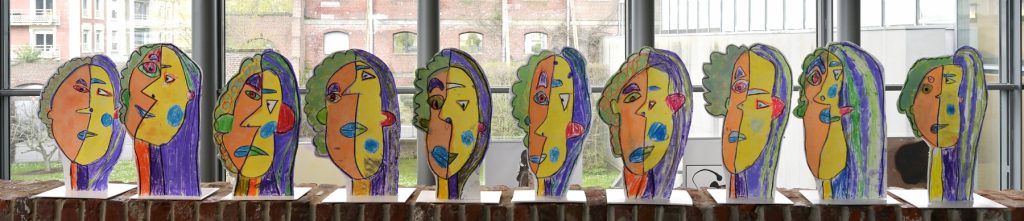
A clear frontal view (middle and senior nursery classes)
A portrait facing straight on for a clear frontal view.
A clear, precise outline for the face.
A tight framing – but not too tight – for an Italian-style bust.
Colourful work on the motif to cover the shoulders.
Odette Pauvert takes us on a journey to Italy, to the Villa Medici.
Our little touch of whimsy will be a very graphic approach to the hair!

> 7 March to 5 July 2026:
La Redoute: Always a step ahead. Fashion, design, advertising

Infinity
A catalogue? No, just a Leporello.
A whole host of products like those in La Redoute’s catalogues?
No, just one object, just its outline, but with a beautiful collection of optional materials.
Through imprints, my object is duplicated and marked with a watermark of perforations, traces and embossings.
Colour enhances the material, and my object takes on an infinite number of possibilities.

About our collections
textiles and clothing

Middle and upper years.
An exploration of clothing, its functions and accessories, combined with a mimed representation of the act of ‘getting dressed’, takes shape in the workshop through a project on adornment using mini-patterns.

Light and shadow

Intermediate and advanced levels.
Identify the light sources and look for their coloured shadows—whether cast, blurred or faded—to create a interplay between light and dark.

TEMPORARY MODELLING

For older children.
Using balls of clay and a few tools, each child shapes a wire frame into a human figure. The modelling clay becomes flesh.
Please note: just as a sculptor rarely keeps this initial modelling stage, the finished piece will be destroyed at the end of the session.

the movement

For adults.
The museum offers an overview of the movement and its representations. Mime allows participants to explore their feelings. The illusion of movement is created using various tools to work on body language or through a series of characters in different poses.

textiles and materials

Intermediate and advanced levels. In the workshop
, visual observation of textile pieces from the museum’s collections, combined with a tactile, auditory and even olfactory exploration of samples, enables students to conceive a creation made from threads, paper, felt, and fabrics that are knotted, stapled or coated.

RENOVATION

For adults. In the exhibition rooms only.
From the former swimming pool to the current museum: landmarks, traces, materials, alterations, decoration… will help visitors understand what the building was and what it has become.

THE DEPTH

Medium and large scales.
How is the concept of depth conveyed?
The importance of colour, composition, different planes and scales is analysed. In the workshop, each child creates their own space by exploring opposites: front/back, big/small, light/dark and hidden/visible.

sight, touch, hearing, smell

Only in the exhibition galleries.
These senses are engaged through the museum’s entire collection, the building itself, the sensory
trail created by Christian Astuguevieille, and tools developed by the team of activity leaders. No art-making takes place; the session consists solely of sensory experiences. The objectives are fourfold: to familiarise participants with these four senses, to awaken them and trigger sensations in response to the museum’s entire collection, and to develop a sensory vocabulary.

screen printing

For older children.
Creating a design using geometric shapes in a screen-printing frame allows you to experiment with one, two or three colours, and thus explore various techniques such as layering, mirroring and edging…

EARTHENWARE SET

Castings of a bear, a toad or a duck await their finishes in white,
black or red clay. A process of design and pattern-making to capture the appearance of the fur, to evoke the animal’s environment. An experiment with clay. The process is nothing but an experiment.
The finished piece is not preserved.

REVERSED STENCILS

Suitable for young children and primary school pupils.
Whether on fabric or paper, shapes take shape. Applying a colour creates the negative spaces. The process continues with another shape and another colour. Reversed stencils become a printing technique.

dyes

Using a variety of dyes (natural or synthetic), the workshop focuses on tie-dye techniques. The dyeing is done using cold-water methods with paint dyes.

weaving

Intermediate and advanced levels.
Through learning about warp, weft and thread intersections, each child creates a woven piece in which strips of fabric are combined with threads, cords, plant materials and paper.

GREENERY REVEALED

Seasonal activity: April to August.
Pressed ferns, sulphated vine leaves, preserved chlorophyll. A herbarium featuring foliage from our dye garden and our collection, with its surprising tannin content. Come and join us for the harvest.

THE ATMOSPHERES

Intermediate and advanced levels.
The subject matter, as well as the colours, composition and format, all contribute to the atmosphere of a piece of art. To gain a better understanding of this, the children transform the artwork through cutting, collage, layering and adding colour.

STILL LIFE

Intermediate and advanced levels.
Observing the elements of still lifes—their composition, the relationships between shapes, colours and materials, and their framing—leads to working on still lifes in the studio using the collage technique.

EXPRESSIONS

Guided by the mime artist, the children discover the various expressions found in the works within the collections. During the workshop, each expression is conveyed through appropriate gestures. Colour is used to emphasise them.

the pace

Rhythm can be created through composition, graphic design, colour, or pattern…
In the studio, sounds and sound effects are translated into patterns of lines, shapes and colours.

The body

An exploration of body image and how it has evolved through the works in our collections serves as the central theme in our galleries. The workshop for younger children involves creating either a character out of paper or clay, or a graphic representation.
For older children, the same approach is used, with a greater emphasis on detail and articulation.

history as an experience…

Children’s section.
A narrative runs through both the artworks and the building. It is illustrated using a single colour. The paintings explore concepts such as dilution, density, thickness and brushwork. The children get to experiment.

THE BESTIARY

From rabbits to horses, via monkeys, tortoises and sea lions, the animals’ postures, coats and the materials used are described. In the workshop, each child creates an animal, either starting with very simplified shapes or, for the older children, by playing with letters or numbers which, through the power of imagination, will be transformed into a bee, a parrot, a swan or a marabou.

A GLIMPSE OF …

Middle and upper years.
Starting with a given image, each child creates a new scene by altering the format, dimensions and framing: I hide, I reveal, I open up, I transform…

the stained-glass window

Stained glass, which features in the museum’s collections and throughout the building, is primarily explored from an aesthetic perspective. In the workshop, the creative process is based on transparency, opacity and translucency.

fabrics and colours

Intermediate and advanced levels.
The concepts of colour palettes and colour schemes are covered before each child creates their own mood board.

fabrics and patterns

Drawing inspiration from the various patterns found in the museum’s textile and fine art collections, each child chooses a pattern (stamp) and reworks it on different materials and in different formats, using a variety of techniques and methods.

CLAY TILE

Intermediate and advanced levels.
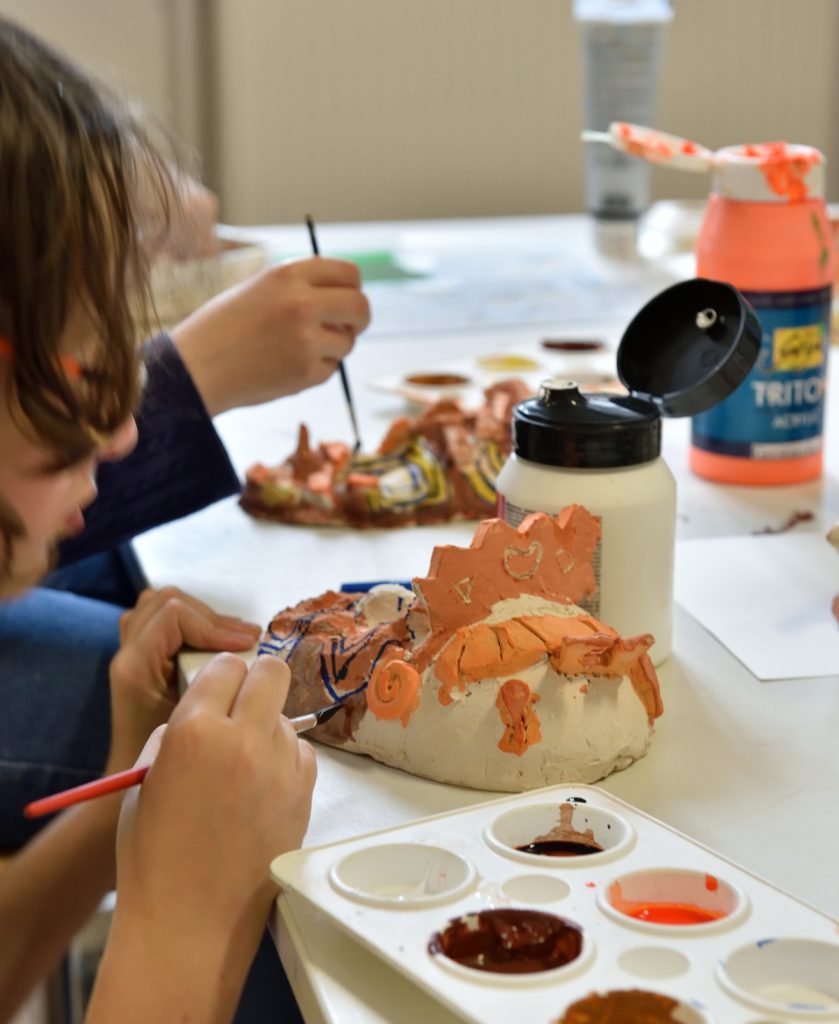
A slab of damp clay for modelling a fish. Tools for embossing, stamping and scoring… to add decorative details. Remove the fish from the slab, test the curves, and ensure it retains its shape without cracking as it dries.
Firing required: €20.

COLOURS

Primary colours, secondary colours, warm and cool tones, contrasts, values and monochromatic schemes are covered. The workshop is all about splashes, brushstrokes and marks, allowing participants to experiment with all these concepts.

ENAMELLING

Suitable for intermediate and advanced levels.
A biscuit egg to be coloured using various glazes or engobes, depending on the participant’s age. Brush-painted designs add the finishing touch. An introduction to glazing that requires firing (20 euros).

The portrait

Whether a bust, a three-quarter view, or a full-length portrait, and whether realistic or not, these descriptive elements enable the creation of a portrait with the aim of framing it.

Land states

A wide variety of materials provide a playground for clay in all its forms: fresh, dry, fired, glazed… The child strokes, smooths, touches lightly, presses, stamps…
The workshop is all about experimentation; the pieces are not kept.

TEXTILES AND OTHER COMPOSITIONS

All-over patterns, half-and-half patterns and other stripes inspire children to create different kinds of designs.
Each child chooses a pattern and arranges it across the page using stripes, checks, all-over patterns, half-and-half patterns…

FIXED POINTS

Middle and upper years. In classrooms only.
The characters in our works adopt certain poses and postures. Through mime, each child imitates these positions, plays with their own body, senses its limits, and becomes aware of the points of support they need. The head, knees, feet and elbows are very useful in this activity, where a few sketches help to highlight our points of support.

THE LANDSCAPE

Middle and upper years.
Observing seascapes, rural and urban landscapes, their fluid and solid elements, and the changing states of the atmosphere enables pupils to apply these concepts in the studio. The children create their own landscapes. A starting point is provided: the horizon… as for the rest, it’s all down to the imagination.

> NUMBER OF PARTICIPANTS

Led by qualified cultural facilitators, the activity sessions last 1½ hours.
Classes are welcome in their entirety. To ensure a comfortable listening experience and high-quality activities, two facilitators supervise classes and groups of nursery school age comprising 20 or more children. For community
centres and day centres, the maximum group size is 12 people.

> PRICES

Residents of Roubaix: Free
Non-residents: €95 on weekdays, €110 on Saturday afternoons, Sundays and public holidays.

> BOOKINGS

Visitor Services
T. + 33 (0)3 20 69 23 67
musee.publics@ville-roubaix.fr

Bookings for young visitors can be made from 9.00 am, so that they can enjoy exclusive access before the museum opens at 11.00 am. However, bookings are available throughout the day.
All bookings must be made at least 30 days in advance of the desired date. Any booking not cancelled at least 72 hours in advance (excluding Saturdays, Sundays and public holidays) will be charged.
This policy also applies to free events and guided tours.

The museum does not have a picnic area.