Teenagers – Activities

Un regard historique, architectural, artistique, sur nos collections permanentes et nos expositions temporaires ? Une grande diversité de thèmes s'offre à vous !

AROUND THE EXHIBITIONS
> 11 October 2025 to 11 January 2026:
Odette Pauvert. Painting as a calling in the Art Deco era.

Perspectives
A pair of figures, two distinct profiles.
A profile that becomes a self-portrait.
A striking frontal composition, a tight frame, clean lines, and an Italian-style bust paying homage to Odette Pauvert and her inspiration drawn from the Quattrocento. In the background, a still life is depicted from a low angle.

> 7 March to 5 July 2026:
La Redoute: Always a step ahead. Fashion, design, advertising

Trends
A collection of three items for the La Redoute exhibition is being put together. Textiles, objects, furniture, toys… anything goes!
Three items for three trend boards.
For each selection, a theme is devised to bring together fabric samples, material textures and colour palettes.

About our collections
textiles and clothing

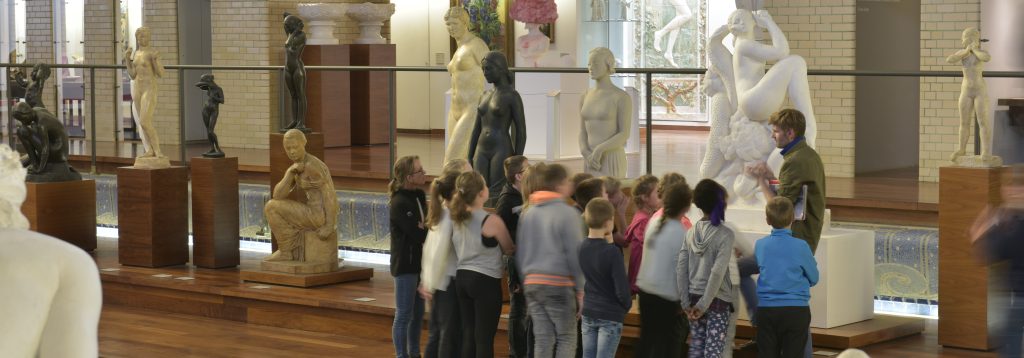
This is not a workshop but a one-hour guided tour. By exploring the garments in the museum’s collections, visitors can examine their shapes, fabrics, colours and accessories, and link them to a particular fashion trend.

TEMPORARY MODELLING

Using balls of clay and a few tools, each child shapes a wire frame into the form of a body. The modelling clay becomes flesh.
Please note: just as a sculptor rarely keeps this initial modelling stage, the finished piece will be destroyed at the end of the session.

the movement

How can movement be depicted?
Creating a flipbook allows you to animate a character by reworking certain ideas. 

textiles and materials

By examining textile pieces from the museum’s collections and exploring samples through touch, sound and even smell, participants can discover the art of felt-making during the workshop.

RENOVATION

From the former swimming pool to the current museum: site surveys, traces, materials, alterations, decoration… will help us understand what the building was and what it has become.

sight, touch, hearing, smell

Only in the galleries.
Sight, touch, hearing and smell are engaged through the museum’s entire collection, the building itself, the sensory trail created by Christian Astuguevieille, and tools developed by the team of activity leaders.
No art-making takes place; the session consists solely of sensory experiences. The objectives are fourfold: to explore these four senses, to awaken them, to trigger sensations in response to the museum’s collections, and to develop a sensory vocabulary.

screen printing

Creating a design using geometric shapes in screen printing allows you to experiment with compositions and colours and to screen print on a variety of substrates.

The Anatomical Bestiary

The animals in our collections—their postures, movements and physical characteristics—lead us to an imaginary X-ray that becomes a reality in the studio, drawing inspiration from animal mandibles, femurs, skulls and tibias. By combining these bones, we create imaginary breeds.

Hygiene advice

In cinemas only
The hygienist architectural concept of *La Piscine*, combined with the depiction in some of our works of the care given to the body, allows us to explore the notions of hygiene.

spatiality

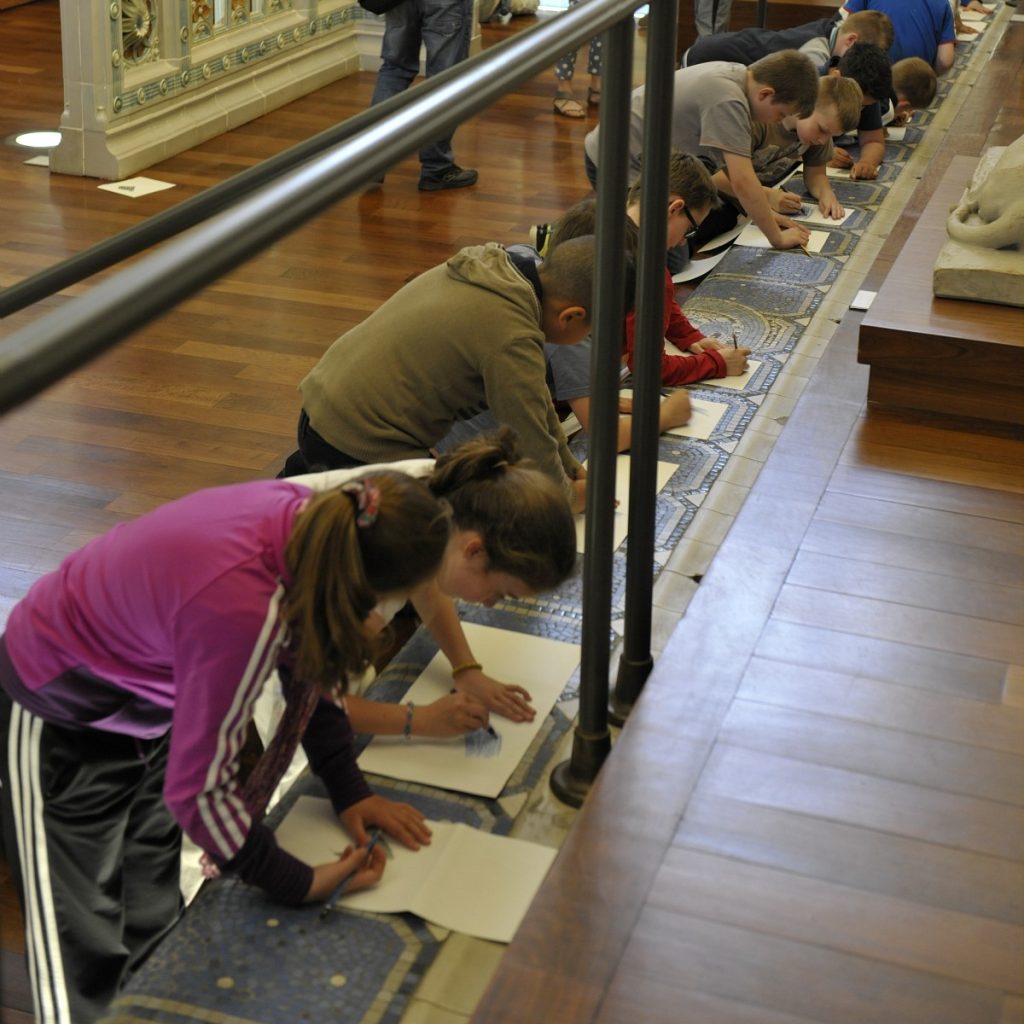
An arch, a vault, an opening; different planes, different lines, different proportions… Painting, sculpture and architecture come together to explore the concept of space. Starting with a systematic drawing, we arrive at a three-dimensional representation of space.

dyes and reserves

From the dyes used to issues relating to colour fixation and colour quality, the workshop explores resist techniques such as binding, the application of paraffin, stitching, folding and fabric compression…

weaving

From warping to weaving, via weaves and finishes… All these technical terms come together to create a woven piece in which various strips of fabric are combined with threads, cords, plant materials, paper… A creation where creativity and technique come together.

GREENERY REVEALED

Seasonal activity: April to August.
Pressed ferns, sulphated vine leaves, preserved chlorophyll. A herbarium featuring foliage from our dye garden and our collection, with its surprising tannin content.
Come and join us for the harvest.

THE ATMOSPHERES

The subject, as well as the colours, composition and format, create the atmosphere of a work. One work, one atmosphere, one interpretation. A different word, a different atmosphere, a different interpretation.

EXPRESSIONS

Whatever the expression, our bodies display outward signs that convey a feeling or an emotion. In our workshops, expressions from the French language allow us to explore our imagination.

the pace

Rhythm can be created through composition, graphic design, colour, pattern, movement… and the creation of various sounds and sound effects allows these elements to be brought to life.

The body

Secondary school
level: The body schema and how it is depicted in the works within the museum’s collections inspire us, in our workshops, to explore a range of poses in which we focus on proportions and articulation. 

Greek mythology

Exclusively in the
Poseidon, Pan, Artemis, Amphitrite and Iphigenia theatres… each named after a story, a belief or a legend from ancient Greece.

THE BESTIARY

Secondary school level: Through 19th- and
20th-century animal collections, students will observe, analyse and describe how the depiction of animals has evolved (species diversification, perspectives on animals, techniques used). In the workshop, students must first capture the attitude and movement of a given animal before rendering its coat.

style and tone

Exclusively in theatres
: a different interpretation offering a fresh perspective on the work. Additional dimensions are brought to life through speech, writing, sound effects and drawing: the creation of a soundscape, exploration of variations in sound and the physicality of the written word… resulting in a new orchestration.

THE BESTIARY

Secondary school level Through 19th- and 20th-century
animal collections, students will observe, analyse and describe how the depiction of animals has evolved (species diversity, perspectives on animals, techniques used). In the workshop, students must capture the posture and movement of a given animal before rendering its coat

colours

Secondary school
level: Colours, combinations, monochromatic schemes, shades and contrasts provide an overview of the museum’s entire collection. In the workshop, the combination of several layers of paint using different materials and tools creates a variety of colourful atmospheres

The outlook

The various techniques used by painters to create the illusion of three-dimensionality. Linear perspective with a central vanishing point is explored during the workshop.

CLAY TILE

A slab of damp clay for shaping a fish. Tools for embossing, stamping and scoring… to decorate it. Remove the fish from the clay, test the curves, and ensure it retains its shape without cracking as it dries.
Firing required: 20 euros

ENAMELLING

A biscuit egg to be coloured using various glazes or engobes, depending on the child’s age. Brush-painted designs add the finishing touch. An introduction to glazing that requires firing (20 euros).

The portrait

Bust portraits, three-quarter-length portraits or full-length portraits, realistic portraits, symbolic portraits, the relationship between form and background… the rendering of facial features, combined with an understanding of proportions, results in a portrait set against a background.

Moulding

Close the two halves of a plaster mould that has been lined with clay. Turn it out to remove the hollow clay animal, which has no head or tail. Finally, use your imagination to fill in the missing parts and create a unique sculpture. Firing recommended (20 euros).

readings

Drawing on the museum’s collections, this activity encourages participants to explore different interpretations of the works through their titles, symbolism, colours and comparative analysis. Working from reproductions in their own workshops, participants challenge or reinterpret the works.

dimensions, format, framing

The impact of dimensions, formats and framing on the artwork. Starting with a given image, each participant creates a new scenario by experimenting with these three concepts.

> NUMBER OF PARTICIPANTS

Classes are permitted to attend in full. Community
centres and day centres: a maximum of 12 people.
Led by qualified cultural facilitators, the activity sessions last two hours.

> PRICES

Residents of Roubaix: Free
Non-residents: €95 on weekdays, €110 on Saturday afternoons, Sundays and public holidays.

> BOOKINGS

Visitor Services
T. + 33 (0)3 20 69 23 67
musee.publics@ville-roubaix.fr

Bookings for young visitors can be made from 9.00 am, so that they can enjoy exclusive access before the museum opens at 11.00 am. However, bookings are available throughout the day.
All bookings must be made at least 30 days before the desired date. Any booking not cancelled at least 72 hours in advance (excluding Saturdays, Sundays and public holidays) will be charged.
This policy also applies to free events and guided tours.

The museum does not have a picnic area.